 Jakob Wolman
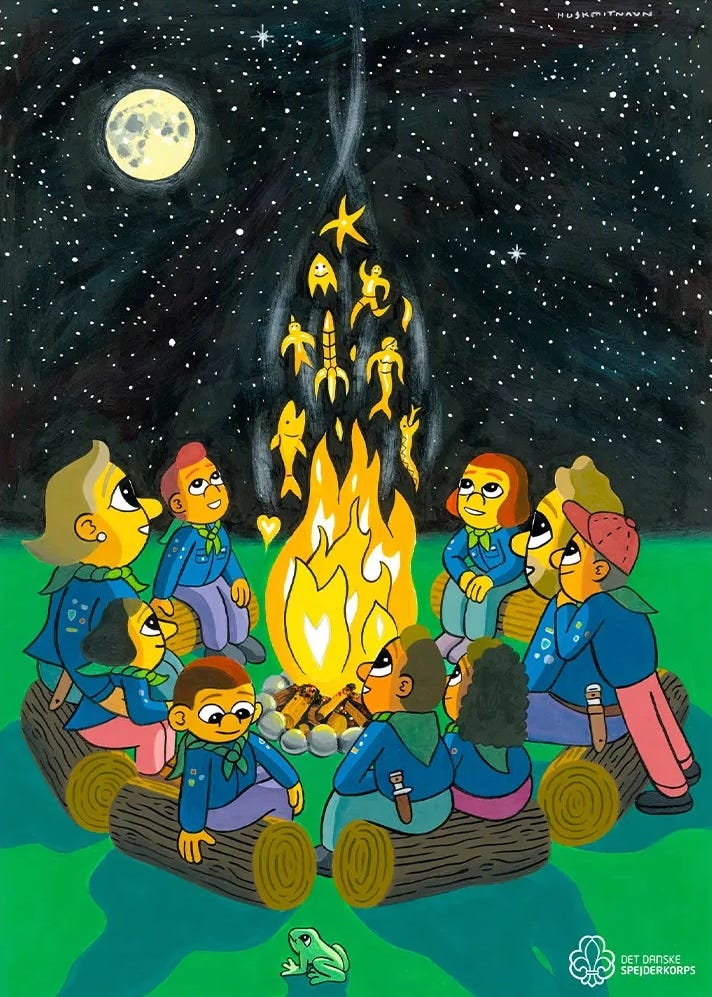 Poster by artistHuskMitNavnfor Det Danske Spejderkorps
I’m a scout.
It is part of my identity, and it has been a constant during most of my life. Scouting teaches you a lot, but people who have not been part of the movement have a hard time appreciating the real value of the lessons. When you see kids tying knots and making fire, what they are actually learning is life skills, collaboration, and strong values.
I sometimes get the question — why do I spend so much of my spare time with the scouts? Why do I put on a uniform to spend hours every week teaching kids? Why do I spend my weekends at camps where I have to comfort crying kids that are not my own, solve conflicts, work physically hard, be outside in cold and rain, and sleep on the ground?
The simple answer is — because I get so much back. I get to watch these kids grow and learn. There is camaraderie, collaboration, and I get to teach and learn the essence of leadership.
These are some of the lessons
Means to an end
From the outside, it seems that scouts mostly learn skills to earn a spot on the TV show Alone. Tie knots, make fire, cook, use an axe, construct things with rope and poles, first aid, use a map and compass and raise tents. What makes the scouts different than outdoor organisations that teach the same methods, or a camping trip with the family? In the scouts, all these skills are means to an end. You need them to be autonomous in the environment in which a scout acts. You need skills to be able to contribute to the group. You need skills to build confidence in your own capacity. You need skills to live the shared values. In the process of learning and teaching skills, you also learn leadership and group dynamics.
Learning by doing
One of the first leadership lessons young scouts learn is what Lord Baden Powell called learning by doing. It is as simple as it sounds. You learn skills (leadership included) by doing them. Practical experience over theoretical knowledge. Try explaining how a specific knot is tied to a group of 9-year-olds. It is virtually impossible. Instead, give them a rope and let them start practicing, playing, and competing. Suddenly, they learn fast. With learning by doing comes the lesson that if you don’t do it, you will not learn. You have to try. In the beginning, you will fail. But there are enough people around you to show you the ropes (literally) and get you on the right path (also literally).
You learn best by a practical application of your skills. That is when you understand what they are good for. It all makes sense when you can combine your rope skills into building a shelter, or your fire-making skills into making a bonfire that will keep you warm.
Self leadership
The most famous scout motto is *be prepared . *To every scout, this means you can only prepare as much. You can have the right equipment, learn the right skills, but your mind has to be prepared to meet novel situations.
I have gotten lost in a forest in the middle of the night without any food or shelter (this was pre-mobile phones). I have hurt myself so that I needed to clean and care for my own wounds. I had to suddenly carry double the load because one in my patrol was hurt. I have had to backtrack bad decisions that affected my whole patrol. Losing two hours to a “shortcut” through the terrain, boiling noodles in juice, because the waterpost was broken and we had mixed juice in all our drinking water, having to move the tent in the middle of the night because we had camped on top of an ant hill, and many more adventures.
With enough skills, you become autonomous to face almost any situation. You learn to look for solutions and face the challenges. Perfection does not matter, and you learn to accept good enough.
Already from a young age, scouts learn to care for themselves. Basic things like keeping your equipment in order, packing your own backpack (and carrying it), remembering to visit the toilet, cooking your food, and much more. Your well-being becomes your own responsibility. This allows scouts to take risks, play wild, and trust their own abilities. Before you can lead others, you must lead yourself.
Shared values
Scouting is built around values. They seep into every activity, the songs we sing and the symbols we carry. There are obvious things like caring for nature and putting the group before yourself. Less obvious are values like contributing to society, being a good friend, and respecting other opinions and faiths. Every time I meet another scout, I know we share the same set of values. The uniform signals a common understanding. This is true at camps, scouting events, and with scouts from other countries. But it is also true in my professional career. When I meet other scouts, there is already a foundation of common trust and understanding.
Learning scout values mean you learn to contribute to something bigger than yourself. You learn to contribute with hard work, even if there is no monetary award.
Scouting differs from team-sport activities because there is no competition. You CAN compete in scouting, and we participate in several competitions every year. But one of the foundational values of scouting is that everyone is welcome. That means nobody will be booted off the team because they are worse at a skill. There are no elite teams, and competitions are not as much about winning as they are about having fun. Kids who also do competitive team sports usually need some time to adjust to this value.
Leading a group with shared values becomes much easier, because there is already a foundation of alignment.
Clarity of direction
I was 10 years old, leading my first patrol. We were at a scouting competition. The patrol had to collect clues to a riddle by solving problems. It became the patrol leader’s role to coordinate who solved what problem, what problems we had already solved, and to collect the clues for the riddle. It dawned on me I was not going to be part of problem-solving (something I was really good at). Instead, I learnt that I had to delegate and coordinate. I had to choose a spot where the patrol would always find me, and send them off on missions. If they couldn’t complete a mission, my role was NOT to jump in and help them solve it, but rather coordinate help. If I left my post, there was a risk of coordination collapsing.
This exercise taught me the value of a clear direction. The person who got an assignment needed to know what they were supposed to do and under what constraints. They did not need to know everything about how the decision was made. It was more important that we acted, rather than waiting for the best person to be available to solve a problem. As time was a contraint it was important to choose missions carefully, and my role was to create an overview of the situation. I had to share progress with everyone and create a shared understanding of the overall mission (solving the riddle).
The scouts teach that it is important to explain why we are doing something, but not to dwell too long. Rather, get people going, and adapt as you go. The older scouts get, the more skills they acquire and the more mature they are, the more autonomous they become. How leadership works evolves as the scouts do.
As an adult, leading kids, you quickly learn to balance between just enough direction, and explaining the overall goal.
The role of a leader
Early on, your group is divided into patrols. Each patrol has an appointed leader and an assistant. The patrols build their identity by having their own symbols, flags, and callsigns.
The leader of a patrol is usually not selected; they are appointed. This means several scouts get a chance at trying leadership in practice. Scouts quickly get an idea of the difference between a good and a bad leader. A well-working leader will resolve conflicts, set clear directions, delegate, and navigate complex situations. A bad leader will yell at their fellow scouts, set strict rules, and try to complete tasks on their own.
In the scouts, we spend a lot of time and effort teaching kids about these traits. We take the appointed leaders aside, observe them, and give them leadership tasks. They become leaders not because they are better than anyone else, but because it is a different job to be done. Once scouts get older, they are sent on leadership courses. I still remember some of them as being the best formal leadership courses I have ever attended. No fancy words, no fluffy theories, no references to books (except Scouting for Boys), and no leadership fads. Instead, plenty of reflection and practice. Watching kids grow into great leaders is one of the most rewarding moments of being an adult scout. Helping them reflect on leadership dilemmas has taught me a lot about my own leadership. It reinforces my firm belief that leadership is a skill that can be taught and trained.
This early focus on leadership also helps scouts find good role models. They look up to some of the great leaders in their group. As the leadership role rotates, scouts also get a chance to help lead and set direction from another position in the group. With an understanding of the challenges of leading a group, scouts can help the appointed leader achieve the patrol’s mission.
My observation from both the military and professional life is that many young people have never had these leadership experiences. Instead, they start out making basic leadership mistakes and assumptions that scouts make when they are around 10 years old. When scouts make it is in a safe environment with good role models to help them improve.
The patrol above all
As a scout, you quickly learn that individual success matters very little, and the success of the group is everything. Competitions, exercies and missions are set up this way. In the excruciating Danish scout race Nathejk, where scouts cross an unknown route, hunted by other scouts, hiking mostly by night and walking a distance of up to 80 km during a weekend, you have not completed the race unless your whole patrol crosses the finish line together. This focus on your patrol teaches scouts early on to take care of each other. It quickly becomes clear that well-functioning groups outperform dysfunctional groups with more skilled individuals. In many scout competitions, you get points for how the patrol is collaborating, how they turn up, and how they support each other.
Scouts learn that nobody gets left behind. If someone is too tired to carry their load, it becomes a problem for the patrol to solve. If someone is hurt and cannot continue, it is the patrol’s responsibility to get them to safety. If someone is sad, homesick, or just has had enough, they often get comforted and encouraged by members of their patrol.
One of the core values of scouting is that everyone is welcome. This makes scout groups diverse. There will be kids with a wide range of ambitions, skills, interests, and maturity. But even if you find someone really annoying, if they don’t chip in or have a hard time acquiring skills, they are part of your patrol. That means you have to treat them with respect, welcome them, and support them. As scouts learn to trust each other and understand each other’s limits, they learn a lot about themselves. Fairness quickly goes out the door as everyone starts chipping in according to their own abilities. A well-functioning patrol and solved missions go above individual performance and fairness.
The strong teams and trust I have observed in scout patrols is possible to build in professional teams as well, but with so many key ingredients missing it becomes much harder. Scouts that have experienced a well functioning patrol know what to look for in a team.
Finally
These are my personal experiences of scouting. They mean much more to me than I can explain in a post. I know others have different experiences, good and bad, from scouting. Over the years, I have observed how my scouting values have been put to work in a professional context, and I have often found partners in people who share the same values.
If you have been a scout, I am curious about your observations. How have the values, skills, and experiences formed you?
If you have never tried scouting, I strongly encourage you to. Find your local scout group. Sign your kids up or start as a leader yourself. No previous skills are required, and you will quickly find yourself welcomed by a group of individuals with strong values. You will be introduced to great outdoor experiences and get the opportunity to both teach and learn from amazing kids.
The Scout movement needs more leaders to enable more kids to experience wild play and the outdoors. Just imagine the type of leaders we would have in the industry if more people learned leadership from scouting.