 Jakob Wolman
We keep hearing stories about superhero developers, teams of rockstars, and dramatic problems that were solved last minute. These stories are fascinating and inspiring, but you don’t want to rely on this way of working.
Inspired by John Cutler’s post I wanted to write about boring teams. Or as Cutler calls them: boringly effective. In the same spirit, I recall a quote from a Swedish soldier deployed to Afghanistan a few years ago, when describing their mission, and the risks of it:
A boring day is a good day
Imagine a boring team. A team where things just work. A team that knows where they are going, knows how to break work down, plan it, build it and ship it. A team that is strong on software craftsmanship, delivers code with high quality that is easy to understand and extend. They write plenty of tests and automate away mundane tasks. If problems are discovered they get nipped in the bud. The team is boring from a no-drama perspective, but they are stable and constantly deliver value to customers. This doesn’t mean it is boring to work in a team like this, rather, it is safe. There can be plenty of big challenges and hard problems to solve. This team will fail plenty, but most failures are small and safe. Failures lead to reflection, learning, and eventually improvements.
This is the team you want, and the environment your organization should strive for creating.
When I hear about an organization that celebrates hero behavior, rewards teams for pulling all-nighters, and constantly enter crunch mode to save a project last minute, I know something is wrong. This kind of drama is a sign things are not working well.

Heroes
When an organization relies heavily on heroes to come and save the day, it is a symptom of several problems. I have observed people hoard information, system access, and knowledge, to constantly be needed. This is mostly a system problem. There is a lack of knowledge sharing, lack of investments in removing technical debt that only the heroes know how to deal with. There is a lack of coaching to help people become unstuck from the hero role, and a lack of investment from the organization to get out of the situation. This can be due to a lack of enough senior engineers in the organization, which in turn often is a symptom of a specific hiring strategy.
Always busy
I have observed both teams, and individuals being measured by how busy they are. We are taught concepts like “important managers have many meetings” and “teams need a full backlog of tasks to work on”. There is a notion that we should always say we are too busy, don’t have time right now, and are working on something more important. Those familiar with lean management and the theory of constraints, know that sweating the assets creates a large work in progress (WIP) and long cycle times (the time it takes from starting work to finishing it). The team will not be able to pick up the most important work when needed. Nobody will be able to work on improvements and polishing, because we are always running for the next project. A system needs slack to be healthy and responsive, and so do individuals. The slack needs to be planned and protected. Priorities need to be clear and constantly updated. Roadmaps need to be regularly revisited and treated as bets or best guesses, rather than prophecies of the future.
Crunching
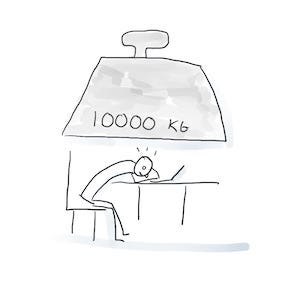
Recurringly forcing a team into crunching mode is said to be a symptom of poor planning. My observation is that it is rather how the organization and team deal with the plan, and deviations from it, that creates weekends and long evenings of work. If a team is forced to stick with a plan because of an arbitrary deadline, it is the drama all over again. Admittedly, some teams deal with real deadlines (as opposed to sadlines, as stated by Liz Keogh) that have to be met. Unexpected events might occur and have to be mitigated, but these should be seldom and exceptions. Teams that constantly work in this mode will not be sustainable, and neither will their work. You want to make sure the team can keep a sustainable pace, and be boringly effective. Identify which dates must be met (because otherwise people, or the company, might die) and which delays are acceptable and mostly will upset someone.
Taskforces
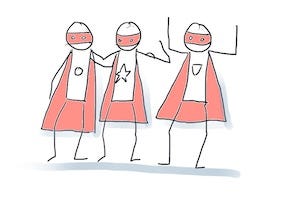
Another common drama is the creation of task forces. This is a symptom of the organization not being able to carry out the most prioritized work in their current structure. Instead, people need to be handpicked for the job, a tiger team created and the organization yet again relies on heroes (or rather the fantastic four) coming to save the day. Once the problem has been solved, the business opportunity met or the feature built people go back to their original place in the organization, often leaving the ownership of what was just created floating around. The disruption of taskforces can be avoided by adapting the organization to the flow of work. Perhaps team structures need to change more often and reteam.

How to be boringly effective
All of the above are symptoms of problems in an organization. The remedies can vary (it depends) and it is all tightly connected to the context you are in. But the general rule of trying to achieve a calm, sustainable pace and boringly effective team is a good goal to strive for. If there is drama, find ways to reduce it. As a system thinker, I strongly believe that the solution lies in the system surrounding the team, and rarely in the team itself, the manager, or the individuals in the team. Instead, focus on adapting things like architecture, organizational design, transparency of work, priorities, work in progress limits, and knowledge sharing. Focus on improving the flow of work. Don’t reward the drama (the heroes, the crunching, the taskforces). Teach teams to put out small fires early, rather than celebrating huge firefighting efforts. Give your organization the goal of becoming boringly effective.
Applicable everywhere?
During an early review of this text, I got the question whether boring teams really are applicable everywhere. Some companies, like startups, are built around the drama. They don’t have enough resources to have the luxury of being boring. They have real deadlines because missed opportunities might make them irrelevant, or block another round of funding, bringing the whole company down. I agree that there are situations where drama is needed. Where there is enough urgency to get all hands on deck and stop everything else. But the key is to avoid these situations, and this goes for small companies dependent on funding too. We have to build sustainable businesses without constantly relying on drama, heroes, and crunching to meet business goals. My ideas in this area are well reflected in DHH and Jason Fried’s books It Doesn’t Have To Be Crazy At Work and the now more than a decade-old Rework. For further reading (or rather listening) I’d also recommend Eliahu Goldratt’s classic The Goal and the brilliant book The Phoenix Project.
I’m curious about your observations of boringly effective teams, and where drama has damaged companies. But I’m also curious about situations you might have observed where the drama lead to something good, and sustainable. Please share in comments below.