 Jakob Wolman
Putting on the high hat and stepping up on the stage
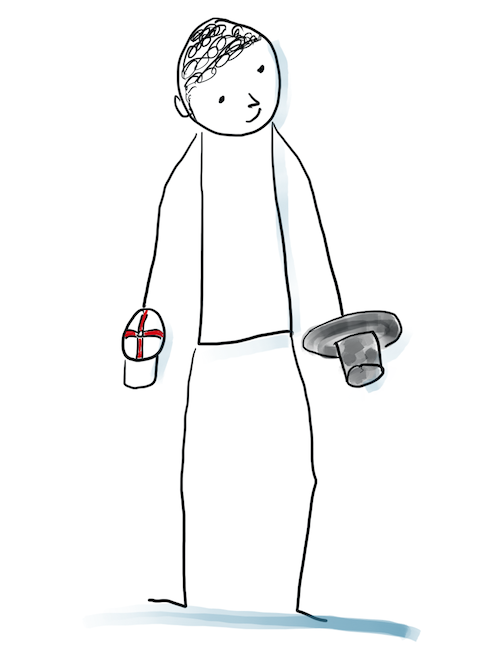 I have always visualized coaches with caps and managers with high hats
Transitioning from maker to multiplier is hard, especially if you are also taking on management responsibilities. About a year and a half ago I transitioned from agile coach to my first management position. My motivation at the time was to become a better coach by understanding the challenges of management. I wanted to learn new skills, and have an opportunity to lead, not just coach, a team. As I am now taking on the mentorship of a new manager, I am reflecting on some of the learnings I’ve had and how my work has changed.
My experience of and long-standing interest in leadership has prepared me well for a role as a manager. Far from all leaders are managers, and far from all managers are leaders. The intersection is powerful, but not enough to be a good manager, and I was new to many responsibilities of a manager.
Changes in expectations
The biggest change in my transition to management has been the expectations of me and the work I do. As an agile coach you are seldom responsible, or accountable for the team’s results. Being a coach is ungrateful, because success is always the team’s success, and you get blamed for the failures. But you are not really accountable. As a manager you are. You can be tasked with reaching certain results, fulfilling goals, and meeting deadlines. With that also comes being part of the team’s success. When the team fails, you are not only blamed but also expected to remedy to make sure the failure is not repeated.
The expectation from the team is also very different. People expect you to act on problems and get them solved. They look to you for decisions, and in some cases for a detailed description of what to work on. As a coach, you can stand comfortably on the sidelines and answer most questions with “it depends”.
Dynamics change
With the change in expectations, the dynamics and your relationship with the team also change.
A coach can be the team’s best friend. Their focus is to improve the team and the environment. Every failure is an opportunity for learning. It is easy to fall into the trap of blaming managers that are part of the system around the team as obstacles. Team members and other managers can easily trust you because you are not a threat.
Stepping into management these dynamics changes. You now have the power to make decisions that will affect people’s lives. You decide who to hire into the team, and in some cases who should leave the team. You set the salary affecting people’s financials. You also have the powers to tell people what to do, when, where, and how to work (but you’d be damned if you use these powers). People become more careful around you, especially team members. After all, you are their manager and we have been taught from early childhood to be careful around the boss (I’ve started cringing at the stereotype boss described in children’s books and films). Depending on the culture of your organization your peers might now treat you as a competitor for resources, power, fame, and glory. Luckily, at Storytel, we support each other to build the best product for our customers, rather than optimizing for our own territory.
Being a manager you should be more careful about your own behavior. Even though every leader models behavior, people are especially affected by their manager. If you set rules you’d better be the one following them thoroughly. You have to think about how your communication can be interpreted. Suggestions can be interpreted as orders, challenges as deadlines, and disagreements as a risk of being fired.
As a manager, you are now part of the system. You might have to defend decisions you disagree with, without blaming anyone else. Likewise, you will have to defend your team, even if you are frustrated with the situation.
Building trust
For both managers and coaches, vulnerability trust is the primary tool. You have to build trust between yourself and the team members to work effectively. Besides focusing on your own relationships you also have to create an environment where team members can trust each other. I have found that it takes more effort, and is much harder to build trust as a manager. Your team members know you hold extra power and there are more situations where you cannot share information openly.
I view trust as a currency. Once you have collected enough, you can invest some in a hard feedback session or a challenge. As a manager, you will find yourself in situations where you have to deliver hard feedback without having had a chance to build up enough trust currency to do it well. You will find yourself in tricky situations that handled well will build trust with the whole team, and handled badly will decrease the overall trust. Letting a team member go is a prime example of such a situation. Showing empathy for the team and quickly solving a painful situation will build trust, but letting someone go in a bad way will scare people and decrease trust.
A seat at the table

As a coach, it is easy to get frustrated about changes happening to you and your team. You often find yourself on the sidelines when important decisions are made that affect the whole system you are trying to improve. As a manager, you get a seat at the table. Admittedly you are not part of every big decision made in the organization, but you are always involved if the decision directly affects your team. Your opinion matters.
When I worked as a coach I often found myself in situations where I knew how to solve a problem, but simply did not have the decision power to make the change happen. Instead, I had to work through others. As a manager, I do have this power but have to use it carefully. This allowed me to implement a system of reteaming and make other systematic decisions I was comfortable with. With power comes responsibility. A good manager has to work even harder to understand how and why people disagree and be very open about a decision being wrong.
The same dynamics described above apply to the larger organization you are a part of. As a coach, I have been part of several big change initiatives, but I was always dependent on someone else making the decision to implement the change. As a manager, I can either work with other managers to make the change happen or start by doing things differently and then inspire others to follow suit.
Strategy vs tactics
When working as a coach I often found time to think strategically. I could zoom out to see the bigger picture and apply systems thinking to my approach. It was easy for me to be an observer to a lot of the tactical decisions and actions going on in the team. As a manager, my calendar magically filled up with meetings. This is natural, as meetings are the arena where most management work happens. There are just so many of them. I also become involved in an endless flurry of tactical decisions and questions (Slack promotes this bad behavior). I have to fight much harder as a manager to make sure I have time to think strategically. I have also discovered that a lot of managers never do this, they are in constant firefighting mode. Even if it is easy to get caught up I have reserved time for strategic thinking, reflections, explorations, and learning. I constantly have to protect that time from being eaten up by tactical issues that need to be dealt with.
Let it go
In the words of a famous Disney princess — you have to let things go. As a coach, I used to step back to allow the team to fill the void, grow and learn. This was expected of me, as the coach is always temporary and should help the team improve. I am applying the same principles as a manager, but it is much more challenging. Mostly because the expectations of the outside world, and the team, are very different. The process of stepping back is slower, and the team is slower to fill the void. As the team grows I have found the act of letting go is essential to survive as a manager. It is simply impossible to be involved in all the details.
Tips from the mentor

As I step into the role of mentoring a new leader I want to distill my learnings into more concrete tips and guides to make the beginning of the journey easier. I still have a lot to learn, but so far I have found the following to be useful to me:
-
Lead the space, not the particles. Or in Drucker’s words “Manage the system, not the people and not the work”. Make decisions and set direction on a systematic level, and not in the details.
-
Build your support system. As a new manager, it is invaluable to have a support system around you. Be it a mentor, a group of peers, a coach, or someone else that you can share your pains with, discuss challenges with and look for guidance from.
-
Find your partners. Find who in your team, and around your team are your partners in making decisions and implementing them. People that are willing to challenge you, but also ready to disagree and align making things happen.
-
Experiment and learn. Don’t be afraid to try things out, but make sure there is a feedback loop. Run the experiment for a while, see if it works and keep adapting.
-
Use data. Have a data-driven approach to your leadership, and use the data that is already available to you. Check what effects your decisions and experiments have on the data. Use both available outcome data (looking at customer behavior) but also on output data (lead time of bugs, WIP, and more).
-
Coaching is a powerful tool. Use it wisely. I am applying coaching in all my 1:1 conversations, and use it for formal coaching sessions. I have also applied it in more informal settings with peers.
-
Remember rule number 6. That means don’t take yourself so seriously. This is one of my most valuable lessons from The art of possibility. You are not more important than anyone else. Your job is just a bit different.
Finally

I am truly enjoying my transition into management, and I am proud of what I have achieved so far. I am constantly learning new things, and I still have a long way to go on this journey. The biggest reward is seeing team members grow, and the team reaching new heights. It’s addictive! At the same time, it is a very challenging journey, and I’ve found myself in deep waters on multiple occasions. It is not for everyone, but if you are curious about management and leadership I encourage you to find a role that allows you to safely try your wings.
Further reading
There are tons of leadership and management books, blogs, and podcasts. As a new manager, I’d recommend reading and listening to a lot, and then picking the raisins out of the cake. There is no single truth and no silver bullets. Learning broadly, experimenting, and learning as you go has been my approach. To me personally, these books have been valuable:
-
The Art Of Possibility by Ben and Rosamund Zander. Best book on self-leadership. You have to be able to lead yourself before you can lead others.
-
The Making Of A Manager by Julie Zhuo. A great introduction when you are starting your management journey.
-
Drive — The Surprising Truth About What Motivates Us by Dan Pink. A must-read to understand what motivates people that do creative work, and why there is a gap between what science knows and what business does.
-
Turn The Ship Around by David Marquet is a great example of how to step back from decision making and make space for the team to fill
-
The Five Dysfunctions Of A Team by Patrick Lencioni. This leadership fable and model is great for understanding team dynamics, and understanding how to improve your team.
-
It Doesn’t Have To Be Crazy At Work by Jason Fried and DHH is a fresh take on the corporate world and how to work sustainably.
-
Nine Lies About Work where Marcus Buckingham and Ashley Goodall debunk myths about work using survey data. To me, it was especially eye-opening that people care more about the team they work in and how they manager act than the organization they work for.