 Jakob Wolman
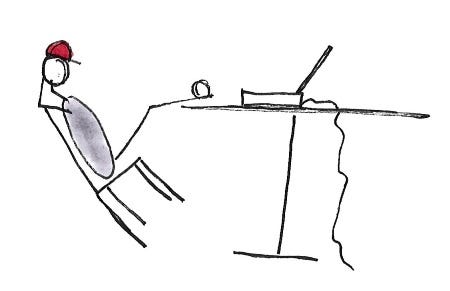
Learn to rest — not to quit.
This is a concept familiar to most people doing endurance sport. As a long distance runner I have a resting pace. If I feel the body is starting to wear, I can fall back to a pace that I can sustain for a long time. It is a pace where I can think clearly, examine my body and energy levels, and create a plan. This is an ability I had to learn. I experimented on long runs, and with the help of a pulse watch and listening to my body I found a resting pace that worked for me.
I have learnt a similar concept in martial arts. If you are fighting in a ring, you must find a place where you feel safe. Find a stance where you feel comfortable. Find a way to protect your body, while still having full view of your opponent. You need to practice to reach a level of comfort. Have your sparring partner pound on you while you focus on protecting yourself without countering. While doing this, practice to think clearly, create a strategy and watch your opponent.
To be able to rest while running or have a safe stance requires a lot of practice. Once experienced, it creates safety and confidence. Knowing you have something sustainable to fall back on gives you the confidence to take risks and experiment.
I believe the analogy of learning to rest can be applied to work, both as individuals and as a team. Identify the way you can regain energy, and what pace is sustainable for you and your team.
Consider what gives you energy. For me it is small things like going for a run (obviously), having a good cup of coffee away from the office, having a deep discussion with a colleague, watching an inspiring talk or just getting a quick nap.
Consider what is your teams sustainable pace and what you need to think clearly. It could be things like agreeing on focusing the whole team on a single task, creating distraction free times during the day or experimenting with 4 day weeks.
Experiment, and find practices that works for you. Create an agreement with your team about sustainable pace and be explicit to your stakeholders and teams around you about what that means. Be explicit to yourself and the environment around you when you are working in this mode. Help each other identify when you are experimenting and taking risks, and when the whole team needs to slow down. Knowing your sustainable pace also helps you being explicit when you are going too fast. The more you learn to slow down and know your pace, the more confidence you will build to run experiments. Try it, and use your normal tools for lead time and throughput to keep track.
And if nothing else works — get yourself a turtle shirt
This post was inspired by running analogies in a thread by Tobbe Gyllebring: