 Jakob Wolman
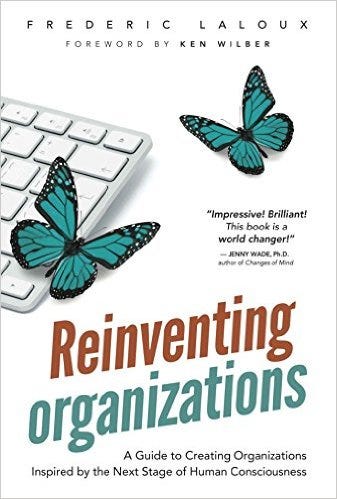
I recently read Reinventing organizations and was inspired. The book provides proof that self managing organizations exist and can be successful. There are many good takeaways from this book, everything from inspiration to practical tips of how to handle conflicts, make decisions and engage people. In this post I will sum up my biggest takeaways and what inspired me.
The model
Laloux describes paradigms that organization operate out of as different colors. Here’s an overview of the model:
 Borrowed fromhere
Impulsive Red
This is the paradigm with a single ruler that makes all decisions and keeps everyone in line with fear. Sincerely hoping there are no legal companies operating on this paradigm.
Conformist Amber
Amber organizations have very strict hierarchies. This creates stability but requires a chain of command to be blindly followed. There is a strict process to be followed. Amber organizations can scale as opposed to red organizations. Still, all the thinking happens at the top, the doing at the bottom. People stay within and identify with their roles that are usually enforced by grades and uniforms. Amber organizations are entirely process driven.
Achievement Orange
Organizations that operate from this paradigm focus on competition, achievements, profit and growth. People in the organization are replaceable cogs in a machinery. As opposed to the hierarchies of amber organizations, orange are driven by meritocracy. The person that knows the most will have the highest status. Orange organizations are process and project driven. Hierarchies exist but everyone has the possibility to climb them. Innovation is promoted and people work across hierarchies. There is a strong sense of accountability. Management sets the direction but people further down the hierarchy are trusted to figure out how to meet these objectives. Recognize the organization? Most companies today operate from this paradigm.
Pluralistic Green
Green organizations focus on the company culture and empowerment of teams. Empowerment because power is still in the hands of upper management but they delegate it to people doing the actual work. Managers are servant leaders and people can take a lot of decisions without managements involvement. There might still be hierarchy and meritocracy but values and culture guides all decisions. Where orange organisations are driven by profit, green organisations have multiple goals, often something connected to social responsibility.
Evolutionary Teal
This book is all about teal organisations and the paradigm they operate from. There are no hierarchies. Instead self management rules allowing people to make decisions anywhere in the organization. A strong purpose is key and all members of the organizations buy in to this purpose. There are no roles but people do what is needed to move towards the purpose. Members of the organization participate as whole human beings, not behind a professional mask. Teal organizations are described as living systems that continuously change and adapt.
A new paradigm
Every paradigm presented above is different and teal is not very common among organizations today. It is important to understand that this is a completely different way of thinking and thinks that makes sense in one paradigm will not in another. To understand teal we have to start thinking teal. The same goes for new members of a teal organization. They have to be given training and time to understand the new way of operating. In the book Laloux uses a lot of examples from existing, pioneering organizations. They can be found in all kind of business (healthcare, power, manufacturing etc). There are large and small organizations proving that this paradigm works in a lot of different situations.
Purpose
One of the keys to the teal paradigm is the strong purpose. Profits and growth is never a purpose but rather helping others, social responsibility, saving the environment or something else that is greater than the single individual. All members of the organization buys in to this purpose and are part of the organization because they believe in the purpose. Decisions that are taken should be aligned with the purpose allowing anyone to work towards the clear purpose. Experiments and risks are taken not because they might generate profit, but because it feels right as it serves the purpose. One story that stuck with me is when Patagonia decided to remove the packaging of their underwear to reduce plastic and shipping. They were warned that this would reduce profits and margin in a highly competitive business. The decision was seen as madness from the perspective of orange organizations. But for a teal organization it was the right thing to do. The result was increased sales because people could see the garment and feel the quality. It also pushed Patagonia to improve the design now and make the garments even more attractive now that it was out of the packaging.
Members of the organization will come up with creative ways to serve the purpose instead of serving the organization or its leaders or owners. I believe this is the shift between extrinsic motivation (bonuses, titles, fear of losing the job etc) that is common driver in orange organizations, and intrinsic motivation (autonomy, mastery, purpose). Once people are intrinsically motivated, working towards a purpose and taking responsibility is no longer an issue, as it usually is in orange organizations.
Self management
Perhaps the most notable difference between teal and other paradigms is self management. This means teams and individuals have the power to take any decision needed to server their purpose. Most organizations have a CEO but no or minimal middle management. Instead there are coaches that will support teams. There is a minimum of staff functions. No HR, legal, finance internal audit etc. All these tasks are handled by the teams themselves. Members of the organization do not hold roles, but do what is needed to serve the purpose. Transparency of information is key to make this work. People fluidly switch between different jobs and can freely choose how they want to contribute.
Advice process
Anyone is allowed to take decisions on behalf of the organization, but most have an advice process. The bigger the decision, the more people you have to ask for advice, involving more people in the decision. It is not to seek consensus, but to ask for advice from your colleagues and checking your decision to the purpose of the organization.
Conflict resolution
All teal organizations have some clear process of how to deal with conflicts. This usually involves the two people trying to solve the conflict themselves and then bringing on advisers as the conflict becomes more complex. Finally the CEO might be brought on as an adviser.
Wholeness
To be able to create a teal organization its members have to participate fully. That means they have to bring their whole self to work and not hide behind a mask of professionalism. They have to fully buy in to the purpose of the organization and participate fully in what is happening. That also means people should be able to personalize their work environment, both decorating but also using the tools that they prefer. There has to be an environment where different opinions can be expressed and accepted and all egos are left outside of the organization. People have to be able to be in touch with their own feelings, express them, and accept the feelings of colleagues.
Becoming a teal organization
Laloux describes two criteria that are absolutely fundamental to become a teal organization: a CEO that “gets it” and a board that supports the transition. Without these two criteria the transformation will eventually fail. He even points out that trying to transform a single team in an organization that operates from another paradigm is a waste of time. Instead we should focus on vertical improvement, making our organization as great as possible based on the current paradigm. Orange organizations can still be great places to work.
Inspiration
I personally think it is almost impossible to transform an existing organization to operate in a teal paradigm. I believe the current system has to die for something based on a new paradigm to emerge. However, I was inspired by the book and believe that we can learn many things. First of all it gives proof (although anecdotal) that it is possible to operate successfully based on a teal paradigm. My explanation comes from systems thinking — orange organizations push standardization of work and are trying to predict the future. Teal has a flexible system that can absorb the unexpected and adapt. I agree with Laloux that this is the future for organizations as we are living in an increasingly complex world.
Even though we might not transform our current organizations to teal, I believe there are many things inspired from the book that we can implement. Even if we can’t change the whole organization, we can change ourselves.
Wholeness
Turn up as a whole person. Bring all of you to work. Get in touch with your feelings, share them, and encourage your colleagues to do the same. Get rid of your professional mask and be the same person you are with your family at work.
Intrinsic motivation
Find your intrinsic motivation. Help others to do the same. Figure out why you are doing this and what your contribution is. I believe a big part of this is clarifying the purpose of your organization and the purpose of your contribution. Make sure people you work with are aligned to the same purpose, and buy in to that purpose rather than making money for yourself or someone else.
Take responsibility
Take responsibility for everything your organization does. Stop saying “it’s not my job” or “it’s not part of my role”. Understand how to serve the purpose in the best way and do what is needed whether someone asks you to or not.