 Jakob Wolman
Sharing knowledge is essential for an learning organization. We want to create an environment where knowledge and ideas are shared between team members, across teams, between managers, across departments and across organizations. In a learning organization people are continuously learning new things. Sharing what you learnt or discovered becomes a reflex and people get inte the habit of building on each other’s ideas.
Have you ever been to a conference where the atmosphere is sharing and caring? And then being met with indifference when trying to share your experiences and new found knowledge in the organisation? Or have you realized that teams work in isolation, reinventing the wheel without sharing their discoveries with the rest of the organisation? I have seen this happen in many teams and companies, and have wondered how to change the attitude towards knowledge sharing.
While at Play For Agile 2016 I got the opportunity to explore ways to gamify knowledge sharing. I got great help from several people, especially from Malte Sussdorff, Joan De Arcayne and Peter Rössler. In the name of sharing I will walk you through how we created a framework. We used a gamification model based on the book For The Win. This model was created by Katrin Elster for Play For Agile 2014.
Gamification model
This was very much an iterative process and what I present here is the end result of what we came up with during the conference.
Objectives
First step is to define the objectives of the game. Why are we doing this? How do we hope to benefit. What are the end goals?
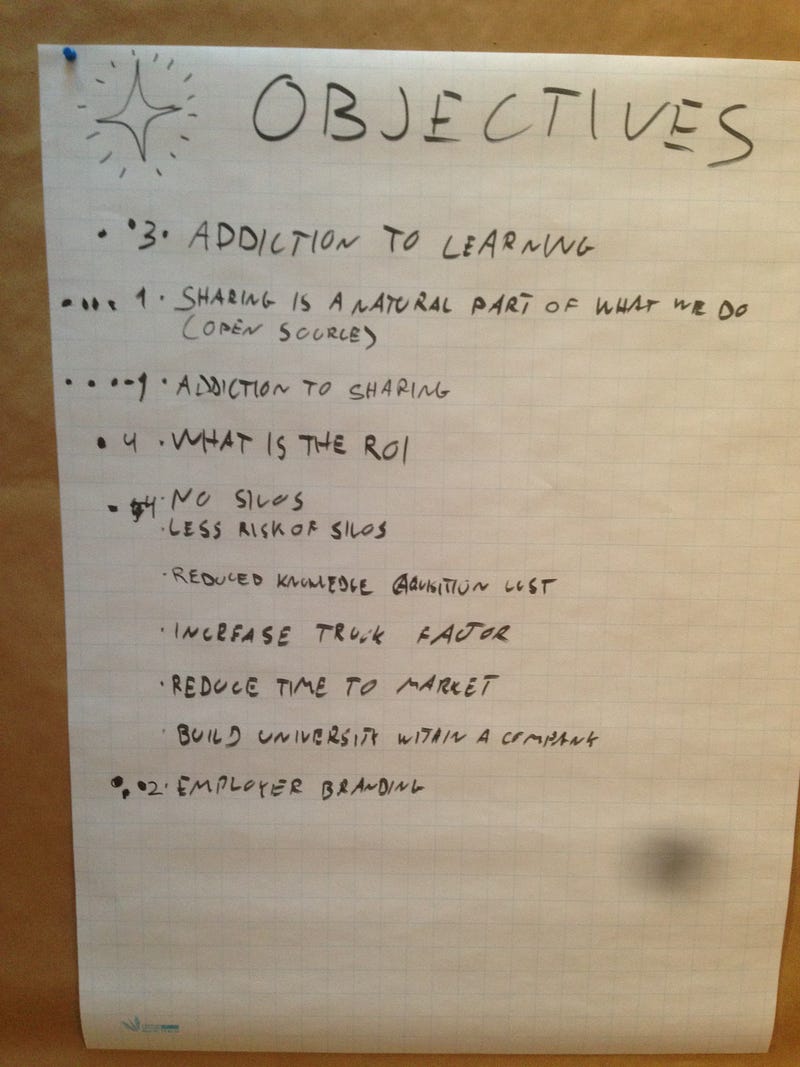
We concluded that our biggest objectives are to make sharing a natural part of what we do and create an addiction to sharing.
Target behaviors
Next step in the gamification process is to define target behaviors. What do we want the players to do, what metrics will we use and how will we give players feedback that they are doing good or bad.
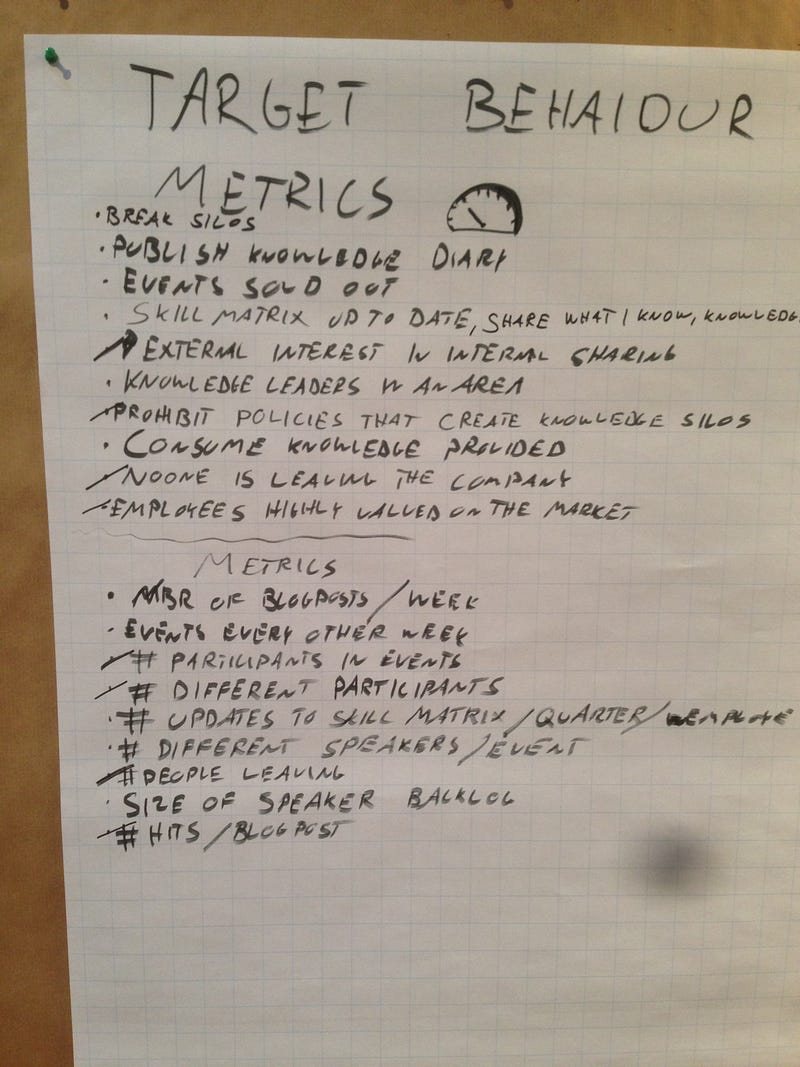
The target behaviors we are after is to increase people’s knowledge. One way to see this is in a skills matrix. People are driven to become knowledge leaders within a specific area. We want to make sure knowledge provided is consumed. We want to break down silos both within the organisation, but also between organisations.
We started with a long list of possible metrics, but as we iterated we crossed out the ones we felt were irrelevant. We ended up with:
-
Number of updates to skill matrix per quarter per employee
-
Number of different speakers per event
-
Size of speaker backlog
Players
Next we have to understand our players. Who are they? What do they care about?
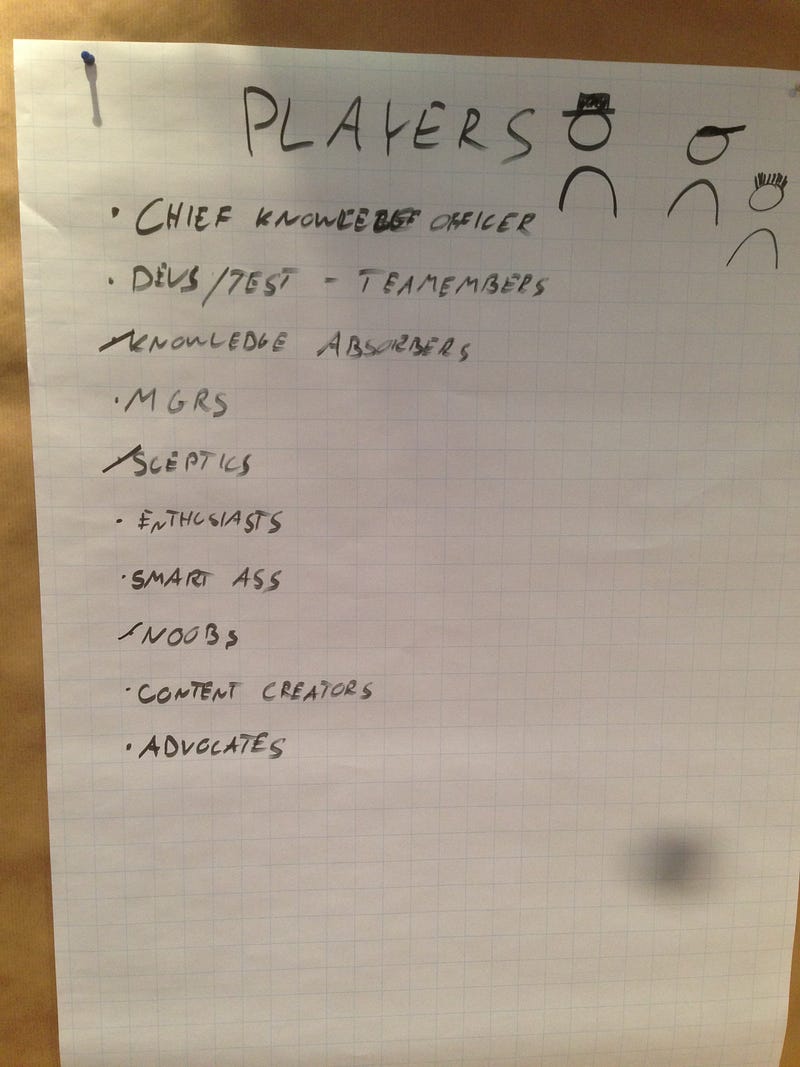
This is challenging to define for knowledge sharing because we don’t want to exclude anyone. Our conclusion was that the topics will filter the audience (managers are not always interested in the latest JS framework) but we should keep it open. However this game is not designed for n00b’s, skeptics or the kind of people that just shop around for knowledge, but never actually produce value (or share what they’ve learnt).
Activity loops
How will we motivate our players to stay in the game?

We want to give players feedback on their actions in such a way that they get motivated to stay in the game and create more actions.
We identified four loops that we found relevant. The most obvious is to motivate people with points, some kind of leaderboard. Each knowledge sharing interaction gives points or badges that players can share.
A variant of this is to use merit money instead of points. Players will be given actually money they can distribute to other players based on their actions.
An obvious motivation for some in this context is fame. The idea is that by inviting people to your events you will get more signups to events or more subscribers to your content. Your audience will grow, and with it your motivation to share more.
Others are motivated by helping people grow. Sharing knowledge will lead to appreciation from participants, and seeing real change in people’s work. the stories of “how you changed my life” is highly motivating.
Fun
The system needs to be fun, so how can we make it work without extrinsic awards?

We identified that the newly acquired knowledge would be the strongest intrinsic motivator. Learning something new and finding out that you understand or can do something you couldn’t do before is a very powerful motivation and very satisfying.
Conclusion
The framework presented in this post is a very rough model that needs a few more iterations before it is ready. But my big takeaway from this process was that the sharing of knowledge is more valuable than the consumption. That means we should focus on material being shared, diversity of topics and what people can learn, rather than focusing on how many people attended an event or read a post. More specifically, it is the number of connections that are valuable. How many people pick up something new that they will use or share further. It is quality in the audience over quantity. This makes it much harder to measure, but still possible.
Next steps
To create a game this model needs a few more iterations but I want to create a first version of this game and run it inside my organisation. To make it simple it will most probably be a point based system with some kind of badges and leaderboards. I was recently given access to all statistics for our internal confluence pages. That means I now have part of the tools to create a point system for digital knowledge sharing. Combining this with statistics from Slack and speaking engagements I should be able to create a first prototype.