 Jakob Wolman
After attending all three modules of the fantastic Creative Leadership course at Kaospilot I want to share what I learnt. An insight I have about myself is that I learn by sharing, and to make what I learnt stick, I will share and discuss with you.
It starts with you
As with any type of leadership or coaching the leader has to be rooted. You have to know yourself and be able to lead yourself to be able to lead others. The intention of this module was to Explore how to lead myself and others in creative collaboration.
Leading space
We are here to lead a space, not the particles of the space. By leading the particles you focus on content, control and outcomes. This limits you as a leader and really puts you in the role of a micromanager. Instead you should focus on the space, the context, communication, support and inspiration. This is the systems thinker approach, leading from the back of the room. As many systems thinker say — focus on the system, not the individuals.
In my life what I stand for is…
As part of rooting and learning more about ourselves we spent some time with an unfinished sentence. It seems simple, but in the right conditions and with the right mindset it is amazing how deep you can go with such a simple task. For me the sentence became *In my life what I stand for is passion. *As we worked in pairs (we always worked in pairs) I got someone else to build on this sentence, and he gave me even more: Passion is my way of dealing with the heritage of ambition.
When taking the perspective of passion, and actively looking for it, I was amazed how easy it was to find. I could see it everywhere. It is clear that when you go looking for it, anchored to a certain perspective, you will find what you are looking for.
Creative aikido
This is probably one of the most powerful tools from the entire course. I have seen similar versions of this, such as the perfection game and plussing. The basic idea of creative aikido is to build on each others ideas in the same way that the art of aikido uses the opponents force. The tool has a simple structure:
-
Accept the force (listen to your opponents idea)
-
Integrate the force (understand the idea)
-
Build on the force (add your own idea on top without criticizing or judging)
-
Offer it back (give the new idea back to the opponent, for him to build on).
When an idea is offered to you you simply say What I love about that is… and we could also…
If you get stuck you can always hand over to your opponent by saying the keyword *shift. *If your opponent gets stuck, or is simply not producing any interesting ideas you can call for new shot that forces the opponent to choose a different view or a new idea.
Creative aikido is a great way to quickly build up ideas. Playing this tends to get crazy, but it works up the creative energy and sets you in a mood for innovation and creating new ideas. As stated in the perfection game — if you can’t improve the idea, it is by definition perfect for you.
Arches
This is a very simple model of any creative process. It is acknowledging that the process moves in arches. Every arch is an exercise — something that brings the process forward. Arches should not be overextended, and should not be ended too early. It is part of your task as a leader to design the arch and know when to end it. I like this way of breaking down the process into steps as it helps keeping the focus on moving the process forward towards an outcome.
Feedback
Giving and taking feedback is always a challenge for a leader. Or rather, the challenge is to do it well. We set up a few rules.
-
Feedback is always given to grow the other person. Always with good intent
-
Feedback is concrete, based on observations, not on an opinion.
-
Feedback is appreciative.
We used the simple format of You served the group well when you… What I would like to see more of is…
This is a powerful way to give useful feedback. The challenge is both in the giving and the taking of feedback. When a room full of people that you have worked with for three days give you feedback on what you have done, and the only answer you are allowed to give is thank you it can get slightly intimidating. Another model that adheres to the rules above, but gives a little more structure, especially for more complex and written feedback is Jurgen Appelo’s feedback wrap.
Leading from any chair
Another big takeaway has been that you can lead the process from any chair, not only from the front of the group. This talks a lot to tribal leadership and leading from the back of the room. But it also speaks to your ability to lead any process, even if you are not the appointed leader. Every participant is responsible for making the process a success and creating an outcome. I keep reminding myself about this when I take part in a process designed by someone else.
From me to we
After being rooted it is time to take it to the team. The intention of this module was to explore how to lead a space for co-creation.
The space
As mentioned before, we want to focus on the space, and not the particles. We have to acknowledge that there is a lot of things going in this space. When creating the space we need to speak to the purpose. That is we need to create a clear message of why we are here and why our work is important. We want to create alignment and use it to create an identity. Then we have to put in place the structure. We want to design our arches, exercises, tasks, groups etc. Finally, we have to acknowledge that there is a lot of drama going on in the space. Drama is good, we need it. It is the choices made, the tensions between members in the space. I liked the metafor of seeing the drama as water, and our job is to channel that water and keep it flowing.
We practiced this learning in a very hands on way, by spending a whole morning with a musician. It is hard to explain the whole experience, but it is something similar to this TED talk by Benjamin Zander. My biggest takeaways from this session was that a conductor does not make a sound himself, he makes others play. When working with an orchestra they all have a grid (rhythm) that give them guidance and synchronize their contributions. To be able to improvise together as a group it is essential that the musicians have a common language to rely on. As a leader it is important to decide which vibe you want to create your space in, and play in.
At a first glance all this learning seemed very specific to making music, but while spending time in this space, and thoroughly reflecting on it, I realized that many of these are valid points in my day to day work.
Simplicity
Perhaps the most important learning for me in this module was the need for simplicity. I have a tendency to complicate things and need to focus on making things simple. My new guidance has become *strong purpose, simple tasks. *If something becomes too simple, you can always add to it later.
From ordinary to extraordinary
In this module the focus was the outcome of the work of the space. At the end of the day that is what counts, and not the process. The intention was *to lead outcomes from ordinary to extraordinary. *Something we quickly identified was the need to stay a little longer with the tension, suffer a little more to get the extraordinary outcome.
Design thinking
We were introduced to a model of design thinking from Stanford’s D-School.
Design thinking is the process of taking something from idea to finished product.
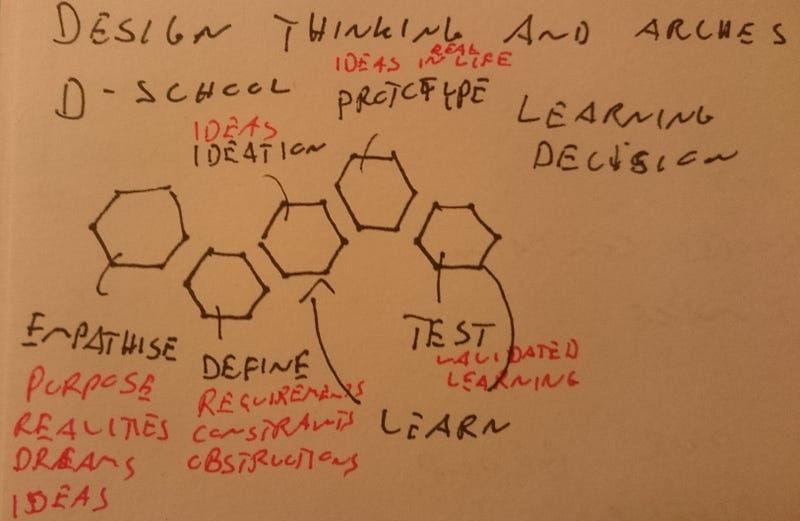 Model for design thinking, straight from my notes, excuse any ugly handwriting and misspelling.
Empathize — create an empathy for the task. This is speaking to the purpose and connecting people with the purpose.
Define — Create the structure of requirements and constraints. This will fuel the creative energy.
Ideas — Generate ideas. As I have learnt with coaching, we want quantity here, not quality. Filtering happens later.
Prototype — Create a prototype of the idea, in real life.
Test — Validate your assumptions about the idea.
Learn — Designing something is an iterative process. Pick up what we learnt when testing the idea, evaluate, refine the idea and iterate.
Some learning I picked up while we discussed this: Speak to the ability of a team to solve a task and always *assume the possibility of alignment. *When working with creative ideas this way of thinking removes your assumptions and lets the team explore spaces you were not able to think of when you designed the process.
Dreams
We learnt to be aware of the dreams in the team. There are low dreams, fears we want to avoid, and high dreams that we want to achieve. We have to acknowledge that both are always present in a group and that there is a moving scale between them. As a leader it is important to turn up with your high dreams, and call on other people’s high dreams. Ask them to move up the scale without intimidating them.
Endings
Ending is essential for the outcome. A great way to approach it is “this is how far we got and this is what we have now”. Create a narrative of the team’s ideas that they will carry with them going forward. Be aware that the extraordinary might be in the team, and not in the outcome of this specific exercise.
Conclusions
First one is that I learnt a lot. There is much more to this course than what I have written above. It is a unique leadership course that I would recommend to anyone interested in leadership. There are three things that makes this course extraordinary and that is Paul, Dave and the class. Paul and Dave are the teachers that lead this whole journey from the back of the room with wisdom, observations and directions. Never seen a pair so synced before. The class consists of creative leaders from different industries, different countries and different worlds. Even though our every day work is very different, we struggle with very similar problems. That is because we deal with people, and we deal with creativity. My mantra that software is made by people, for people really proves itself here.
Hopefully we will continue learning and supporting each other without teachers. I am hoping this is just the beginning of our journey as creative leaders, and I want my fellows with me on that journey. Being able to reach for support from someone that you share a common language with is very powerful and important to me.
Further reading
-
The art of possibility — Benjamin Zander and Rosamund Stone Zander
-
Creativity Inc — Ed Catmull and Amay Wallace